[ Page 1 ]



go to [page 2]
Early Soviet jet / rocket aircraft developed near the end of second world war and shortly after 1945 were heavily based on information obtained from German jet aircraft, some of them being captured with also their jet engines and analysed. (This was also the case for the American development of jets by the way and the French Atar jet engine).
Aircraft such as the German Messerschmitt Me-262 and Me-163 Komet and various jet prototypes were used, and more importantly, their engines studied, duplicated and adopted.
Mikoyan, Gurevich, Yakovlev and Tichonravov were the Soviet pioneers in this area.
Models of early soviet jets in 1/72 scale covered:
-
1. Bereznjak Isajev
BI-1
2. Tikhonravov I-302P
3. Mikoyan Gurevich MiG-9
4. Mikoyan Gurevich I-270 [on page 2]
5. Yakovlev Jak-17 [on page 2]
6. Yakovlev Jak-23 [on page 2]
This aircraft was a rocket propelled aircraft that flew already in May 1942. It was very small, linen and wood was used in several parts. The rocket was a D-14-1100 of 1,406Kg trust. The experiments gave data that were used in other Soviet designs.
The wingspan was about 6,48 m, length 6,4 m and empty weight 960 kg and a usual flying weight of 1680 kg. Maximum estimated speed was to be about 990 km/hr!
First some gliding flights were made to know the handling characteristics with the aircraft being pulled to height usually with a Pe-2. Overall performance was good and over 675 km/h was reached and a very fast climb but endurance was not very long. The BI-1 was also modified with two tip mounted air breathing engines. During a test March 27, 1943 with probably 800 km/hr reached, the plane crashed, killing its pilot. It was never used in combat.
( Beginning 1946 a BI-1bis was made with improvements and a different engine).
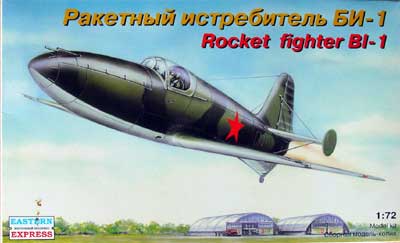
The Eastern
Express kit (no. 72203 ) in 1/72 scale has about 40 short
run injection
plastic parts and it is a very small model. The kit was I believed
originally
issued by VES model , Voronez from
Biela, Russia
and the Pioneer kit is probably the same mould. Accuracy seems to be
quite
good, a plane is in the Monino museum.
The
surface detail is very fine with
nice engraving with lots of small detail but it is short-run plastic.
Cleaning
up and filling tiny gaps with putty is required and a very fine hands
as
the model measures only 9 x 10 cm. It's box is very large, at least 8
kits
could be in it! The decals are not very good. Instructions are nice
with
history details in English also of this aircraft.
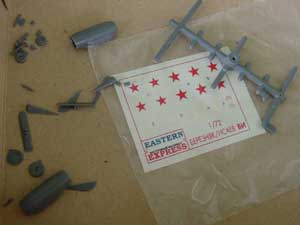
The
tiny canopy is clear but one
piece. The kit gets you a neat model and some extra options
can be
made for which parts are supplied. You get also a set of skis.
I
selected the version with the tip
mounted engines.
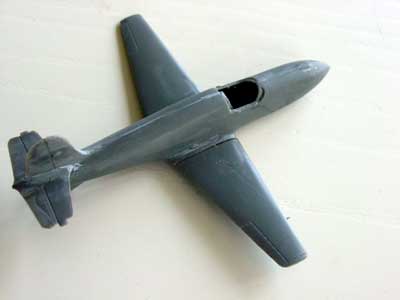
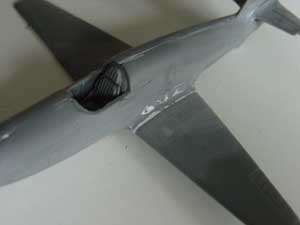
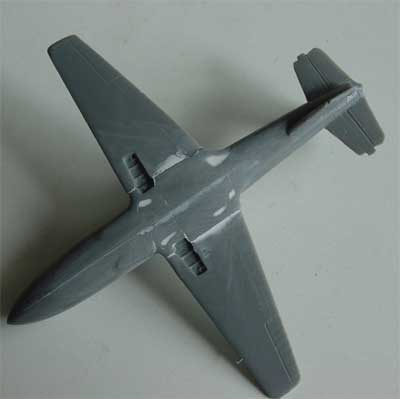
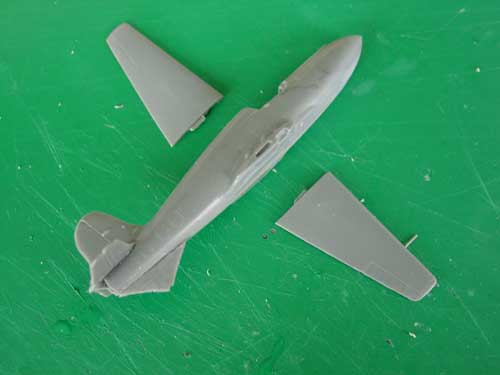
Interior
colours are probably ghost
grey with a green seat cushions.
===================
The
"ramjet' pods were fitted to
the wing tips; these were fitted on the sixth BI-1 according to the
instructions.
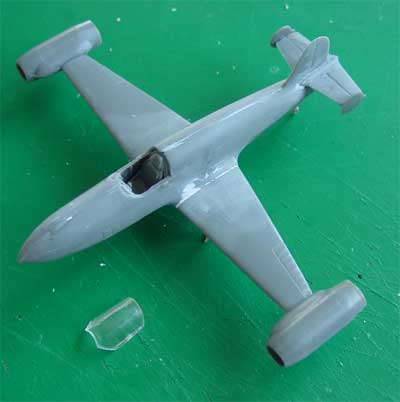
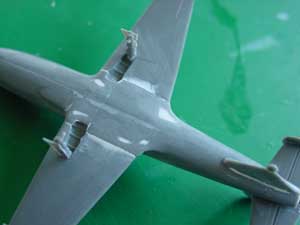
Gear attached and the "end plates" to the stabilizer. The cockpit is very small but some nice details are provided in the kit. Cockpit was added with some white glue to fill the small gaps.
Exterior colours are dark and medium green (Humbrol 159 and 120 enamels) upper surface and common light blue Humbrol 65 ? lower finish.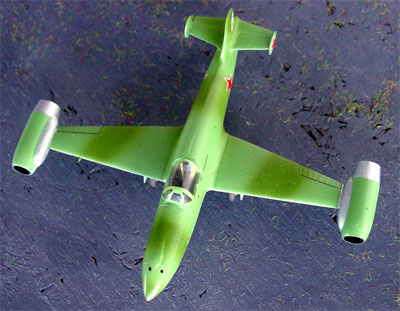
Red Stars had tiny white edges supplied in the kit; these stars were all cut out with scissors and applied. Be careful as they are very thin and tend to break up.
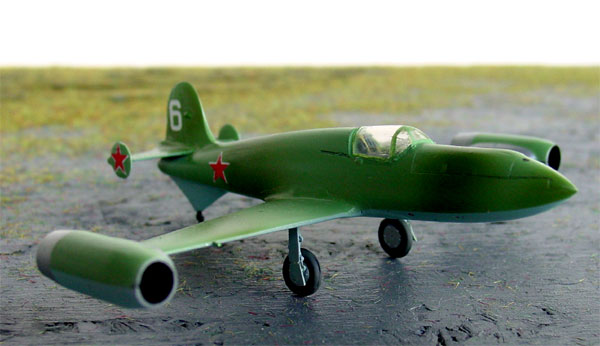
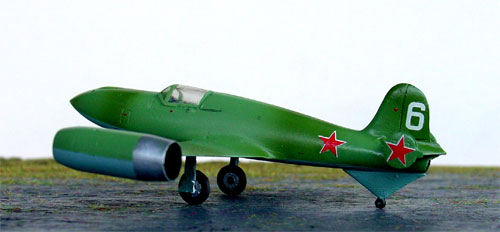
A very nice
special model to the collection.
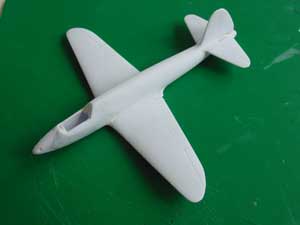
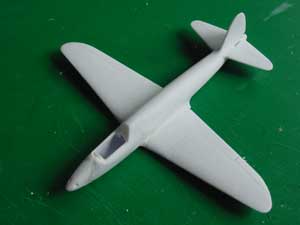
2. Tikhonravov I-302P (1943)
Designer M.K.Tikhonravov was asked to investigate rocket propulsion for aircraft in the early 1940s and he came up with a design for a small plane with a rocket in the tail and what seems to be two ramjets under the wingtips.
An unpowered glider was flown in 1943 to test the flight characteristics. It was not flown with the envisaged engines as they could not be delivered. So the I-302 never materialized into the envisaged rocket plane.
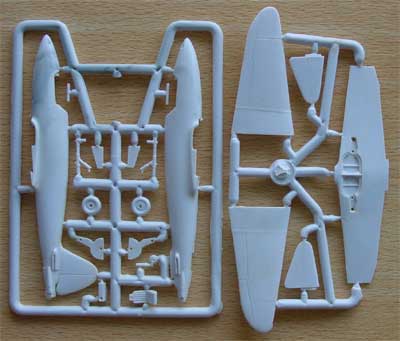
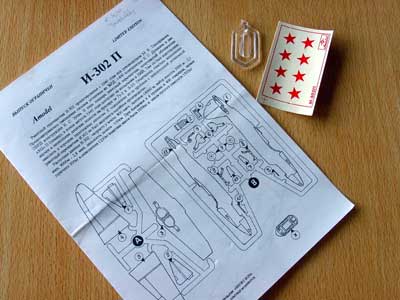
The Amodel
(kit no 7220) in 1/72 scale has
only about 15 parts
and is short-run. It represents the flown test glider. It is a limited
edition short run kit and needs some parts cleaning up. 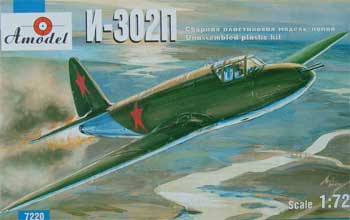
For the single
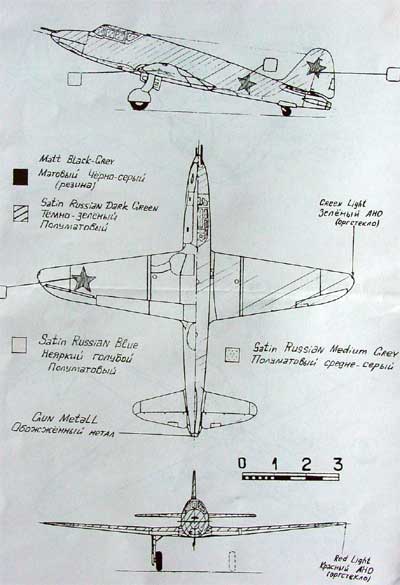
plane, the red-stars are provided as decals.
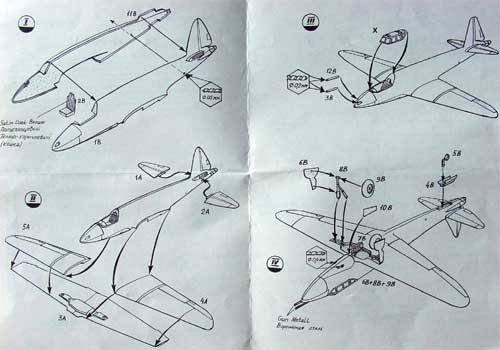
You will need
some obvious filling and putty in areas. The wing-fuselage
joint
needs considerable filling with putty but otherwise the kit was made
straight
out of the box. There is hardly any detail in the cockpit but it is
very
small. The painting of the canopy frames is challenging, use painted
decal
cut in strips here. Also, the gun ports were drilled out.
 ...
...
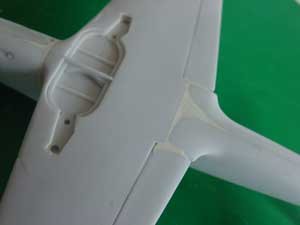
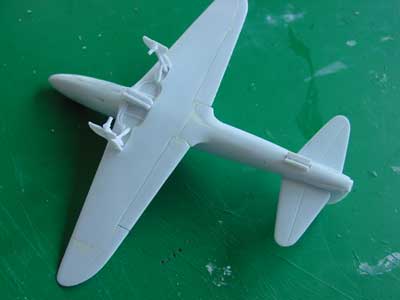
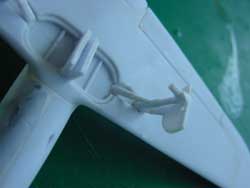
Lower
view with legs attached. I
drilled two holes to receive the gear legs.
 ...
...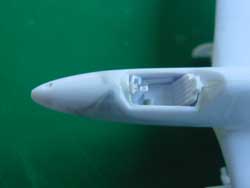
Some
details from card and strip
were added to the small cockpit.
Colours applied were upper green of Humbrol 105 and the lower surfaces Humbrol 65 light blue.
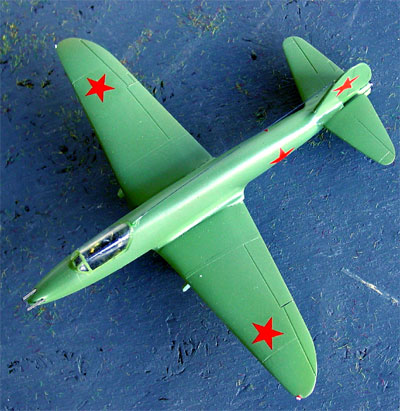
The
cockpit did not fit very well,
some white glue was used to close gaps. Two metal pins from a paperclip
("gun simulation? ) were added to the nose.
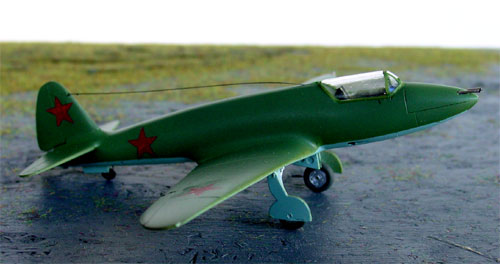
A
wire antenna completed the model.
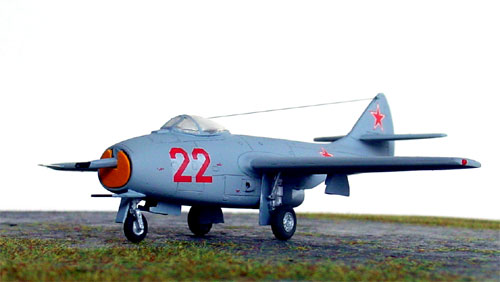
Developed after the Second World War, the MiG-9 (prototype known as I-300) became the first operational fighter of the Soviet air force. It first flew in April 1946. The jet engine was based on captured German jet BMW 003 engines of the WWII later developed into the RD-20 / 21 engine. Between 1946-1948 about 600 MiG-9 aircraft were built. Some were also donated to China later on.
-
Modifications
to initial MiG-9:
I-301T/«FT» - The I-301/I-301T - MiG-9L: was a two-seat trainer development of the MiG-9. Two built.
I-305 - Version of the MiG-9 with two Lyulka TR-1 engines. One built.
MiG-9F/I-307 - A development of MiG-9 with two RD-21 engines.
MiG-9FR/I-308 - The recco modification of MiG-9. Two RD-21 engines.
The MiG-9 was replaced by the much better MiG-15.
Amodel
(kit no. 7206) in 1/72 scale has
issued a model
of this little jet and it is short run which requires some cleaning up
of the plastic parts.
[ NOTE: later
on, Amodel issued an updated MiG-9 kit, no. 7299 ]
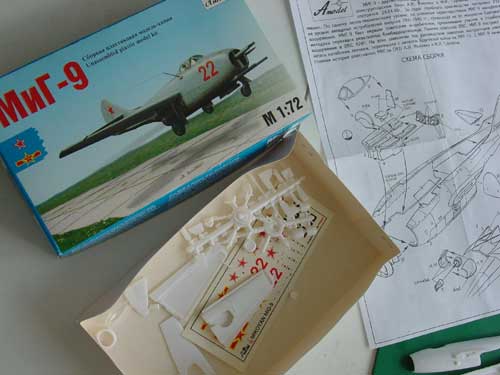
About 40 parts
and a small decal sheet for a 1950 and 1958 MiG-9 are included and a
Chinese
MiG-9 are included. The basic plane is light grey. Wingspan
and
length accuracy of the model is quite good and it looks like a MiG-9.
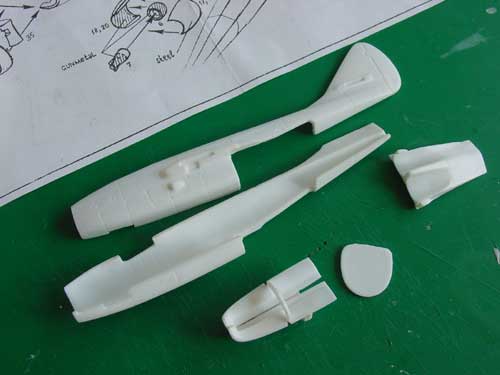
The trailing
edges of the flying surfaces of wing and stabilizers needs thinning
them.
I merely sanded the areas here and this results in a much better
appearance
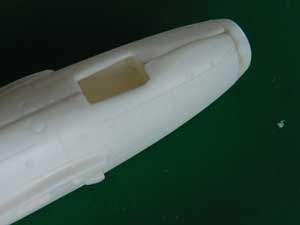 ...
...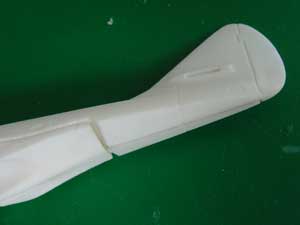
a large gap is on the lower
end of the tail
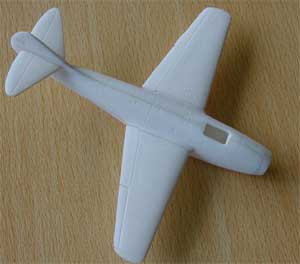
There is some
detail in the basic cockpit with a tub and seat. It is very small and
not
much can be seen later on. Panels are engraved but a bit rough. With
some
work a nice little model can be made. Putty is required at the joints
and
especially at the wing roots. I strengthened the wing-fuselage joint
with
some small metal pins with holes drilled in the appropriate locations.
I also replaced
the pitot tubes and gun barrel.
The MiG-9 got as all other models a grey base coat. It was discovered that there is some plastic shrinkage ("irregularities") op the upper wings and the fuselage spine needs some extra sanding.
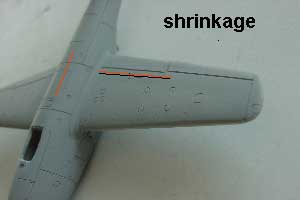
Final colour used was an airbrushed overall grey coat of light grey using Humbrol 128 enamel. It was decided to put a cover on the intake to add some colour and to mask the very rough model intake.
It was found later that the cockpit glass had a step at the wind shield. A small thin piece of card to have a smoother step.
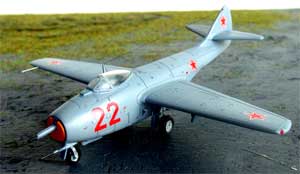
Only
the red stars and the number
were used of the decals. Cutt out the stars with scissors to remove
decal
film. Fine stencilling was simulated with some red paint applied with a
tooth pick.
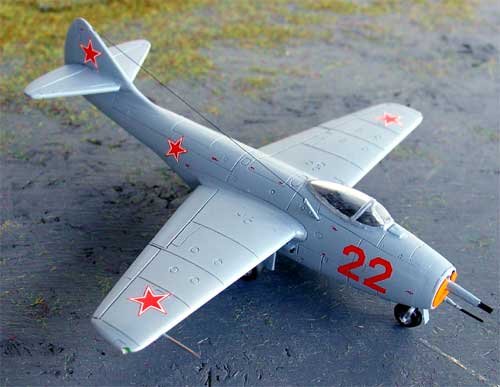
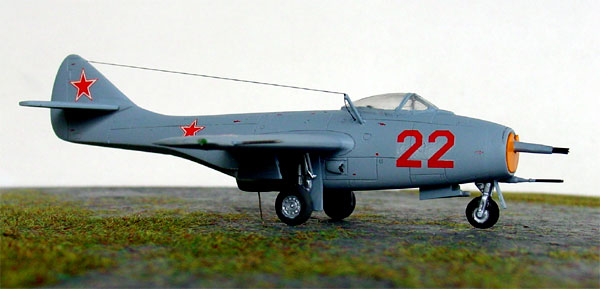
Unfortunately
to prevent tail sitting,
a very thin metal wire was required below the exhaust area.
A
wire antenna and gun nozzles were
added as well as a pitot tube on the right wing leading edge.
Back to 1/72 models.......
General References:
OKB MiG, a history of the design bureau and it aircraft, Butowski & Jay Miller
Dutch magazine "Luchtvaartkennis 1974-04" about the BI-1.


(c) Copyright Meindert "designer"/ All rights reserved/ Amsterdam The Netherlands.Your comments are welcomed by webmaster
Created this page
July 8, 2005