MAIN PAGE
Tamiya + Academy + Hasegawa


Modelling reports by Meindert de Vreeze
 ..
.. ..
..
..
 .
. ..
..
 .....
.....
Go directly to 1/32 kits...
Check out my 1/72 scale F-16 kits as well...
Introduction
The first YF-16
flew 30 years ago in January 1974 and since that time the F-16 has appeared
in many sub-variants. I will not go into too much detail on the history
and technical details, on the internet many sources can be found .
For the F-16
the Block number is the main indicator of the type of the F-16 airframe,
as several distinct variants of the aircraft are covered by the same model
suffix letter. For example, while the Block 32 and Block 50 are vastly
different subtypes, both are F-16Cs. Early F-16As were produced to Block
1, 5 and 10 and 15 standards. Various modification standards within the
same block numbers are identified by an added letter e.g for example
Block 15A, 15B etc.
F-16A/B
The F-16A (single
seater ) /B (two seater) appeared first as the blocks 1, 5, 10 and 20.
It started
with the Block 1 and Block 5 F-16s built between mid-1978 and 1981. Most
of these were later upgraded as Block 10. The first F-16 subtypes were
equipped with the Pratt and Whitney F100 engine, original small intake (normal shock inlet) and had small horizontal stabilizers. They had the standard vertical tail fairing USAF style without parachute pack.
Block 15 introduced
two new hard points under the inlet chin and larger stabilizers with around
30% more area; this was done by extending the trailing edge. These were
provided to improve directional stability while carrying loads on the new
hard points. Provision was also made for AIM-7 Sparrow air-to-air missiles
(AAM).
Various European
NATO countries ordered the type early on like The Netherlands and
Belgium, Norway, Danmark (many made under license by Fokker in The Netherlands).
Many Block
15 aircraft later received an Operational Capability Upgrade (OCU), adding
a data transfer cartridge, a radar altimeter and various radar enhancements.
Systems also enabled the usage of the AGM-65 Maverick air-to-ground (AGM)
missile, AGM-119 Penguin anti-shipping-missile (ASM for Norway) and AIM-120
Advanced Medium-Range Air-to-Air Missile (AMRAAM) with their different LAU-129 launchers. The first Block 15 OCU
built as such was delivered in January 1988. Blocks 15 built from 1988
were powered by the F100-PW-220 and had a larger head-up display (HUD)
in addition to the OCU modifications. The US Air National Guard started
to use in 1980 the Block 15 for Air Defense. It was called the ADF version,
with the AN/APG-66A radar. It also had new internal systems and externally
a spot illumination light mounted on the port side of the forward fuselage
nose. The IFF antennas in front of the canopy are fitted on a raised "bolted on" panel and this can be seen.
ADF
had a short career but Italy leased (under PEACE CEASAR) to cope with Eurofighter
program delays some 34 aircraft as a intermediate period from 2007 - 2012
form the USA.
(Some F-16 used
by particular air forces had also a illumination light on the nose, below
the RHAWS fairing; for the Norwegean it is on the left side, for the Greece
F-16C's on the right side).
Belgian F-16's
also had their own ECM system, the Rapport III with not a parachute in
the tail fairing but an ECM box. Later, this system was replaced by the Carapace
system as Rapport did not function.
Block 20 was
for Taiwan under the PEACE Fenghuang program, with the AN/APG-66(v) 2
radar and locally sourced IFF and other equipment. The aircraft were "similar"
to the initial European Mid Life Update (MLU) configuration, which Lockheed
Martin also refers to as Block 20.
F-16C/D
The Block 25
F-16 came in 1984 and was referred to as F-16C/D (C for single seater,
D for two seater) and delivered to the USAF. Capable of using the AIM-120
AMRAAM with their different LAU-129 launchers with a new AN/APG-68 radar with increased range and better
resolution with on the the nose cone streamlined anti-lightning strips fitted. New systems needed space that was created by a thicker vertical
tail base with a longer dorsal fin on which an easy recognizable antenna is fitted.
The cockpit received two head-down multi-function displays,
new up-front controls, a larger HUD, data transfer unit, radar altimeter
and jam resistant UHF radio. Panellines
also are slightly different at some locations. Powered initially by the
Pratt and Whitney F100-PW-200,
this was later generally substituted for the F100-PW-220E version. On
many aircraft the AN/APX-113 IFF system was introduced which is
distinguishable through the 4 IFF antennas in front of the canopy
(called "bird slicers"). Also on
later
Block 25 and future F-16 Blocks at the wing leading edge
a pair of RHAW
antennas were fitted ("beer cans") on the C/D (also retrofitted on many
earlier manufactured C/D aircraft). Two chaff dispensers were also
fitted on the lower fuselage fairing next to the stabilizers with 2
extra ones from Fiscal Year 87 and later Block 30 and 32.
Block 30 came
around 1987 and introduced for the first time a new more powerful engine for the F-16: the General Electric
F110-GE-100 that required more air so a larger intake "Big Mouth" MCID "modular common inlet duct")
was fitted to cope with a larger air mass to provide its full thrust at
lower altitudes. The throttle on the left console is also slightly different
than on previous versions. Also because of the larger overall aircraft weight, thicker
wider wheels were used and that required bulged main wheel doors
with a slight bump. The
2 main gear landing lights were moved and situated as on some earlier
blocks in a single unit inside the nose gear door.
The thicker vertical tail base got some additional
vents: one on each side at the kink and one midway on top of the base leading
edge aft of the larger antenna. And a vent-intake on the right side below
the rear cockpit glass. Often, also two additional chaff flare dispensers
were fitted on the left lower fuselage fairing next to the stabilizers aft of the wing trailing
edge. These were extra as to the two already in place.
Some strengthening modifications were also often done with two extra metal re-enforcement stiffener or called "scab" plates on each side of the tail base next to the antenna and two wing strengthening plates at the upper wing roots. Often also on the nose 2 small RAM nose side panels were installed below the IFF "bird slicers".
F-16N and
TF-16N built for the US Navy were derivatives of the F-16C/D Block 30
type. They were used as dissimilar air combat trainers, and though simplified
aircraft have a beefed up structure and no cannon. F-16N's were operated
between 1987 and 1994 in the USA.
The Pratt and Whitney F100 and General Electric F110 engines became now choices for future Blocks: those ending on "0" featuring the General Electric engine and those ending on "2 " the Pratt and Whitney engine.
Block 32 retained
the Pratt and Whitney F100 engine with what became termed as the "normal
shock inlet" (the standard older intake) but now got the uprated Pratt and Whitney F100-PW-220.
(The USAF Thunderbirds also used that Block for the demonstration team
but without armament such as the gun and with a fuel smoke pipe below the
exhaust). Externally, some vents and chaff flare dispensers were standard
as well as the few strengthening stiffener plates as introduced on the Block
30 (see above). On the nose 2 small RAM nose side panels were installed below the IFF "bird slicers".
Block 30/32
aircraft could use a wider range of weapons, like the AGM-45 Shrike and
AGM-88 High Speed Anti-Radiation Missile (HARM). Self defense was improved
from the introduction of the Block 30D by doubling the number of chaff/flare
dispensers carried.
NOTE: early
F-16's before and up to block 30 have at the slat at the inboard position
only "2" slat rotating fingers. Later block beyond block 30 F-16 have there
"3" fingers.
Block 40/42
"Night Falcon".
The Block 40/42
F-16s were also officially designated as either F-16C for single-seaters,
or as F-16D for two-seaters. A proposal to re-designate US Air Force examples
as F-16G and H's was rejected, but led to the adoption of the informal
F-16CG and F-16DG. The F-16CG/DG Block 40 has the General Electric F110-GE-100
engine and the Block 42 the Pratt and Whitney
F100 engine. (It was proposed that the Block 50/52
would become the F-16J and F-16K (two-seater), resulting in the commonly
used F-16CJ and F-16DJ description for those versions).
The newer Block 40/42 aircraft appeared 1988 and were "night" capable planes with various targeting systems and pods. For example the LANTIRN (Low Altitude, Navigation and Targeting, Infra-Red for Night) pod, consisting of the AN/AAQ-13 with a FLIR (forward looking infrared) and terrain following radar for navigation and AN/AAQ-14 with infra-red imager and laser range finder for targeting. Cockpits were mostly black to improve pilot vision. (The designation added to the Block no. "+" was often also used to indicate targeting systems capability).
Pods were mounted under the starboard/ right and port/left side chin hard points respectively. On the lower nose aft of the radar nose and in front of the large air intake the panel lines are also slightly different as well as near the arrestor hook area. There is also a small intake on the right side about 1 feet aft of the main gear bay. Four sets of ALE-47 chaff dispensers were fitted on the lower fuselage fairings, a pair aft of the wing trailing edge and 2 x 1 next to stabilizers controlled by the AN/ALR-56M Advanced Radar Warning System (which was also standard on the Block 50/52 and later retrofitted to all US F-16C/Ds).
The
undercarriage was also strengthened and extended to provide
adequate clearance for the pods and the carriage of extensive
air-to-ground
munitions, including the Raytheon Paveway laser-guided family. These
also resulted in thicker main "with different hub" wheels and
again the"bulged" main landing gear doors to accommodate these in the
bays. The
2 main gear landing lights were moved and situated as on some earlier
blocks in a single unit inside the nose gear door.
Avionics had also been substantially been improved. In the cockpit a larger GEC-Marconi wide-angle, holographic HUD portrayed data provided by the LANTIRN system in addition to basic flight information. An improved AN/APG-68V radar was introduced and a GPS receiver (a flat circular panel seen on the spine). On the nose radar cone the anti-lightning streamlined strips were also fitted. An AN/ALE-47 chaff/flare dispenser was added. In front of the port/left main gear bay a different wider and larger ECS exhaust is also fitted for better cooling the systems.
Strengthening
plates on the Block 40/42 comprised two plates next to the tail base fronts
and 8 "finger" style plates on the upper mid fuselage section.
Israel received
F-16D Block 40 aircraft as a specialized precision strike and suppression of enemy
air defense (SEAD) aircraft, with a weapon systems officer in the rear
seat. A long, box-shaped dorsal spine accommodated extra avionics, believed
to be an ELISRA electronic warfare system. Additionally some of its two-seat
Block 30 aircraft have also received the modification, while all of the
F-16I were built with it as standard.
A similar external
modification was incorporated on some Singaporean F-16D Block 52s, and
the Chilean and Polish two-seaters.
Block 50/52 F-16C/D were derived from the SEAD. Beginning 1993 the Block 50D and Block 52D planes were delivered, also referred to as the F-16CJ / DJ capable for Wild Weasel tasks. As delivered to the US Air Force they did not have the LANTIRN capability and fitted with a lighter HUD, but capable of carrying and firing the AGM-88 HARM. They introduced the AN/APG-68 (v) 5 radar with new capability and the 4 IFF antennas in front of the canopy (called "bird slicers"). Also in the mostly black finished cockpit the pilot could use night vision goggles.
The structure was strengthened as standard so no external re-enforment stiffening plates are seen on the mid fuselage and wing roots. There is on the Block 50 / 52 also a differently shaped "L shaped" panel line on right side of the fuselage spine below the air-to-air refuelling receptable door.
As noted earlier different engines were used: Block 50 got the General Electric F110-GE-129 and the block 52 got the uprated Pratt and Whitney F100-PW-229 engine. This can also be seen externally with slightly different engine exhaust types with their plates/ vanes. Again the stronger main gear was used as standard with thicker wheels that now had a different wheel hub with "12 holes" and the "bulged" main wheel doors. And the landing lights moved and situated in a single unit inside the nose gear door.
On the right cockpit side a small vent is seen as well as a small inlet on top of the intake/vent on the left side. On the thick base vertical tail again some additional vents: one on each side at the kink and one midway on top of the base leading edge aft of the larger antenna.
Later these
types were also capable of using the AN/ASQ213 HARM Targeting System pod
and able to fire AGM-84 Harpoon ASMs. While not a feature of USAF Block 50/52,
those ordered by overseas customers could be equipped to carry LANTIRN
pods. Externally, now 2 plus a pair of chaff flare dispensers were standard as introduced on the
Block
30 (see above).
In addition
to the Fort Worth production line, F-16C/D Block 50/52 aircraft have been
built in South Korea ("KF-16") and Turkey. Poland and Greece also now operate
the type but there are slight variations. Pakistan also has the type but
with French sensor pods (though probably receiving US systems later on).
Program CCIP upgraded about 650 F-16s to a common standard, and work commenced in September 2001 in several phases on the Block 50 and 52 and the Block 40 / 42 to allow the many systems and weapons to be used. (see below).
Block 60 "Desert Falcon" first flew end 2003 and was at that time the most advanced type. Block 60 single- and two-seaters were designated as F-16E and F and based on the F-16C/D Block 50 and 52. The Block 60 got a new engine, the F110-GE-132.
Conformal fuel tanks (CFT) can be installed on top of the mid-fuselage adding around 375 Imp gal (1,705 lit) of extra fuel with little effect on flying qualities. It thus has much larger take-off weights (so wider wheels and bulged main doors) and stronger structures.
New systems
include also new avionics and the Northrop Grumman AN/APG-80 Active Electronically
Scanned Array (AESA); this is an agile beam radar, providing a massive
leap in capability even when compared to the latest AN/APG-68(V)9. The
radar is mounted in a pitot tube-less radome, with three fuselage-mounted
pitots. The cooling system required by the radar is mounted in the enlarged
ventral tail fairing in the single-Beaters and the dorsal spine of two-seaters.
(The spine also houses the engine start controller, data link radio, 'blackbox'
crash data recorder, electronic warfare receiver, aft transmitter and chaff/flare
dispensers.).
Block 60 type
also has a Northrop Grumman AN/ASQ-28 Integrated FLIR and Targeting System
(IFTS). This IFTS consists of a FLIR mounted on the nose and a small targeting
pod attached on the port side of the inlet.
The pilot can
use night vision goggles and the cockpit has three large displays with
its main colours being black for night flying. The Falcon Edge electronic
warfare suite comprises onboard jammers and even a towed decoy.
F-16V
This "Viper"
version first flew October 2015 and and Singapore was the buyer of this
new version (along with later Block 52). It has a completely new SABR radar
set with the CAPES suite.
QF-16
This is remotely
piloted unmanned F-16 obtained from spare stocks tested in 2013.
Upgrading
various F-16 blocks
Alongside new
production aircraft several different upgrade programs have been implemented
on existing F-16s, the most important being the Mid Life Update (MLU)
in
several phases and the Common Configuration Implementation Program (CCIP).
So existing F-16 airframes were upgraded for various air forces.
Starting in
1992 , the MLU upgrade was an European true multi-national program (EPAF)
intended to gave the type a true all weather and night capability. Many
of the older European F-16 aircraft using in NATO air forces (including
F-16A "block 15" KLu RNLAF planes) were updated. These European F-16A/Bs
including those of the RNeth AF (KLu) were re-designated as F-16AM/BM following
modification. The MLU upgrade was done in several phases during the years from M1 to M5.
First
stages
of the MLU involved the refurbishment of older F-16 Block 15s with a
cockpit
similar to the Block 50/52, with an upgraded radar and capable for the
AIM-120 AMRAAM with their different LAU-129 launchers (also on the wing tips). Update includes a new computer, a better radar
(APG-66v2)
including multi-target locking; complete re-design of the cockpit main
instrument panels (a.o. new full-color MFDs and a larger HUD) and
cockpit
colours are more black, with new style flight stick and two larger
displays. They retained the small main air intake and Pratt and Whitney F100
engine.
Strengthening was also done with stiffening re-enforcement plates on most MLU upgrades that comprised two plates next to the tail base fronts and 8 "finger" style plates on the upper mid fuselage section (similar to the Block 40/ 42).
CCIP upgraded about 650 F-16s to a common standard, and work commenced in September 2001. The other main parts of the airframe were unchanged so still the normal intake, engine and original wheels. But the landing lights moved from the main gear to a single unit at the nose gear door and night vision goggles were often used as well (so the lights avoid blinding the pilot).
In phase M3 (about 2004) are an advanced IFF system (the 4 antennas "bird slicers" seen in front of the canopy; note that these may vary for other versions where the fairings are on a "raised" panel like on Korean and Turkish F-16's). Also an IDM Improved Data Modem, a DTS Digital Terrain System, and capabilities for satellite navigation, Night Vision Goggles (and thus the darker painted cockpit inside areas), FLIR (forward-looking infrared), all-weather defense and bombing (including full IFR and night capabilities), BVR Beyond Visual range air combat (AIM-120 AMRAAM), approaching missile detection, anti-radiation, and laser targeting for high-accuracy bombing. The MARS (medium altitude recon system) was also introduced. Also the Pratt and Whitney engines were uprated to PW220 standard.
MLU phase M4 (around 2006) introduced a new computer with better software that enables latest generation AIM-9L and AIM-9X and IRIS-T missiles to be fired with the LAU-129 launchers. Phase M5 of 2009 introduced a better precision navigation system and better capabilities for weapons like the GBU-49.
Also in 2009 the MARS can be replaced by the Recce-Lite (RL) recon system with infrared sensors. The pilot also received the JHMCS (joint helmet mounted cueing system) that projects information on a helmet screen for the pilot which is visible with a small "T shaped" bar on the left inside canopy frame.
MLU M6 started
2012 introduced a better IFF.
Other upgrades
The latest
options are upgrades to Block 50+/52+. The
greatest advance of the "+ " came in the form of
the radar, the AN/APG-68(v)9 and the night fighting and bad weather
capability to used targeting pods and guided weapons. Other options for
Block 50+/52+ include
helmet-mounted cueing systems.
Customers can choose their own configuration depending on their requirements, resulting in considerable differences between aircraft built for different countries. Greece's Peace Xenia IV aircraft incorporate around a 30% structural change from the original US Air Force Block 50/ 52 examples, while the Israeli F-16I (see below) have a similar percentage difference from the Greek aircraft, as they are optimized for the long-range strike role with enlarged spines.
Conformal Fuel tanks (CFT) can be fitted on top of the centre
fuselage as well as the standard external tanks carried on wing pylons.
For lower radar visibility RAM techniques were also introduced. Some F-16 Blocks have a RAM panel on the nose and near the wing trailing edges. Also various "tinted" transparent coatings are used on the canopy. Large variations are seen: sometimes unchanged, applied in a tinted sheen and on double seaters forward and rear canopy sections RAM tinted or not. Tint colours seen were transparent brown, orange, yellow and all shades in between! Even on F-16's within a single squadron. These RAM upgrades were also used on many NATO air forces' MLU upgraded F-16's.
Other
RAM techniques are the usage of special paint called "HAVE GLASS"
particularly on USAF Block 50 F-16's. The paint adds metallic hue to the
basic grey F-16 colours.
F-16I
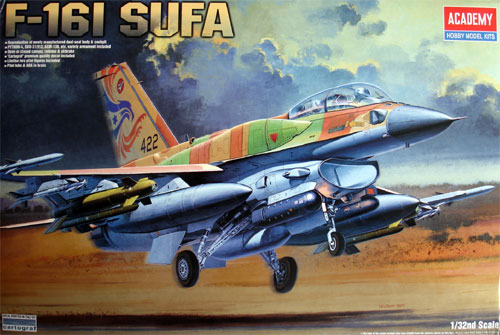
SUFA
The F-16I nicknamed
"Sufa" (Storm) was manufactured by "Lockheed Martin" (which took over General Dynamics) and equipped with a
Pratt and Whitney F100-PW-229 (IPE) engine. Numerous modifications were
made with advanced systems developed in Israel according to the IAF's specifications
by the country's defense industries. SUFA (Hebrew for "storm") is based
on current Block 50/52 production aircraft. The F-16I
has a 23,600-kilogram take-off weight, considerably more than the earlier
F-16s in IAF service, and is armed with the AMRAAM air-to-air missile.
The SUFA has several features like:
- Conformal
Fuel Tanks (CFT) manufactured by the "Israel Aircraft Industries"
and which increase amount of internal fuel by 50%. The tanks are installed
one the plane's upper fuselage and conform to it's figure.
- AGP-68(V)X
Synthetic aperture radar (SAR) that enables the tracking of ground targets
day or night, at any type of weather.
- Modernized
cockpit is for the pilot and the rear cockpit is configured for the weapons
systems operator or, with the change of a single switch, for a pilot instructor.
System are a wide angle head up display from Elop and high definition (120ppi)
4in x 4in colour multi-function displays supplied by Astronautics CA of
Petah Tikva, Israel. Other new features include a colour moving map display,
digital video recording equipment, cockpit lighting and external strip
lighting compatible with night vision goggles and a high capacity data
transfer set. A Helmet Mounted Cueing System of Israeli design is extra
to the goggles which F-16I pilots and navigators wear.
- Dorsal spine
Avionics Compartment aft of the canopy with advanced electronic warfare
systems developed in Israel. These systems are improved models based on
those installed in the F-15I. The aircraft features advanced Israeli communication
systems as well.
- capability for larger 600-gallon
wing tanks improving the aircraft's range and persistence. The tanks are
mounted on unejectable supports (which looks a bit odd).
- satellite
communication of Elta and Rafael, including a UHF radio with new encoding
methods and long distance relay capabilities.
- capability
to use special weapons like the Python missile and equipment like the Litening
II pod. This is a targeting and navigation pod that presents pilots with
real-time, Forward Looking Infra-Red (FLIR) and Charge Coupled Device (CCD)
imagery. The LANTIRN pod can also be used.
The F-16I SUFA made its maiden flight in December 2003 with first aircraft delivered to the IAF at the Ramon Air Base, in February 2004.
April 2012,
the 4,500 F-16 'th was delivered (being a Moroccan F-16C Block 52). The
F-16 has been delivered to dozens of countries and large numbers are still
operated. In the NATO countries many of the F-16's will be replaced by
the Lockheed F-35 JSF starting in 2018.
Deliveries
of advanced F-16's continue, though at a limited pace in various "Peace" programs to US Allies...
See also the
references below and F-16.net for more actual real plane F-16 data....
F-16 kits in 1/32 scale discussed here are:
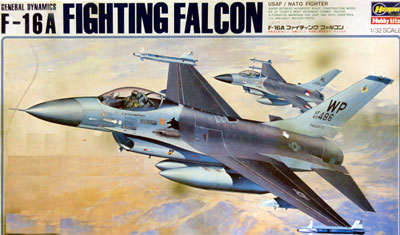
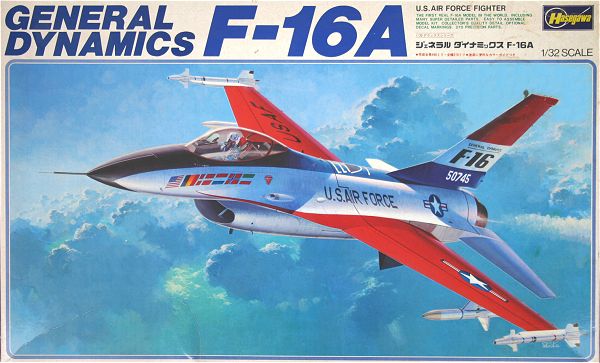
- Hasegawa
kits (checkout out here...) including Venezuelan
F-16A
- Tamiya
kit (see below or direct to modelling
Report here......)
- Academy
F-16CG kit (see below or direct to modelling
Report....)
- Academy
F-16I SUFA two seater (checkout here)
- Academy
conversion to a F-16B KLu ORANGE JUMPER...
- Revell
:
check here for conversion to a Japanese F-2...
- Tips for
converting Tamiya Thunderbird into a F-16A
- modelling F-16C
Thunderbirds using the Hasegawa kit
Check out 1/72 scale F-16 kits here ...
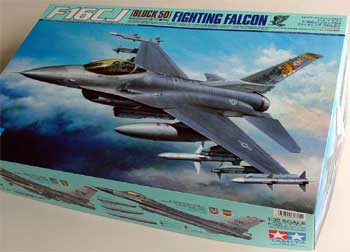
| Tamiya
1/32
F-16CJ Fighting falcon Kit number # 60315 |
Academy
1/32
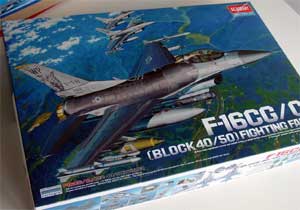
F-16CG /CJ Fighting Falcon Kit number # 12101 |
| PRICE: | |
| About EURO 135,- in the Netherlands; issued as kit December 2004 | about 80 EURO !! ( 40% lower than Tamiya kit) |
| SUBTYPE: | |
| the
model is a F-16CJ (Block 50 D) and has the big mouth intake for the later
F110 engine. These were used on later F-16 types such as the later made
C's.
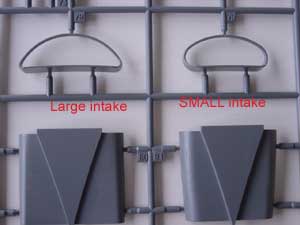
tamiya was first with issuing a Big Mouth kit, but Academy also has it now as option in their kit. Other correctly included parts are the thinker wheels and bulged main doors. Other details are the thick base vertical tail. It still is a single seater F-16 however. I discovered that the IFF panel as found on the MLU upgraded Falcons is included as part # 17. |
Several block versions
can be made of this kit: Block 40 or 42 F-16CG or Block 50/52 F-16CJ.
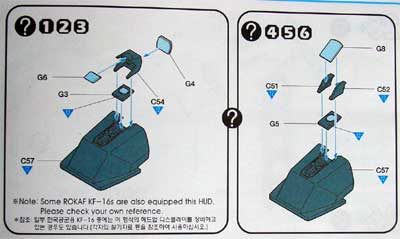
Small or Big Mouth intake!; 2 types of engine fans (F100 and PW 100) and 2 types of exhausts. Several smaller parts can be found in this kit for the different blocks and countries that used the F-16: parachute tail fairing, IFF antennas (as found on MLU upgraded F-16's), 2 types of HUDs . [ Note: you get a "thick" base vertical tail and also one set of main tires and gear so if you want to make earlier F-16's blocks, you will need some cross kitting with some parts from the Hasegawa 1/32 kit #S27 ]. |
| INSTRUCTIONS: | |
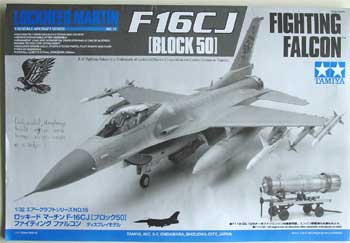
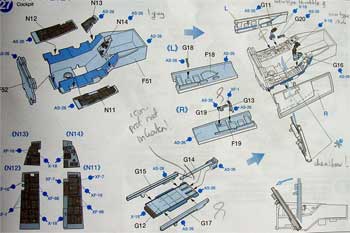
Nice
booklet but as usual bit crowded Tamiya style. 65 steps with only Tamiya
Paint color number and paint names.
 |
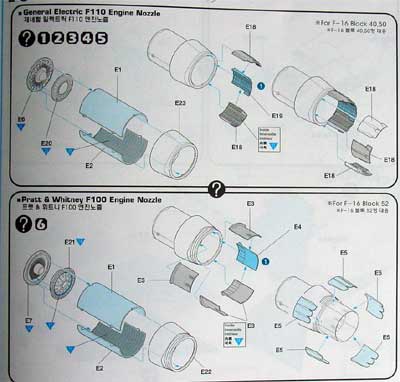
Fine, with 35 steps.
Comparable to the F-18 style instructions, with FS number but no paint
numbers.
 |
| PARTS: | |
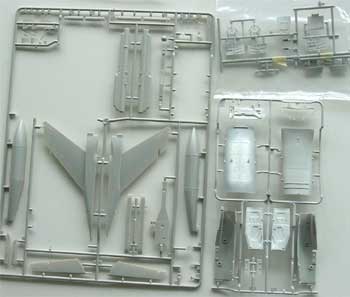
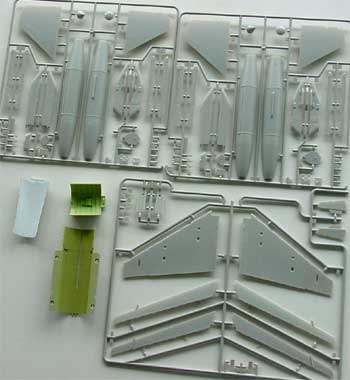
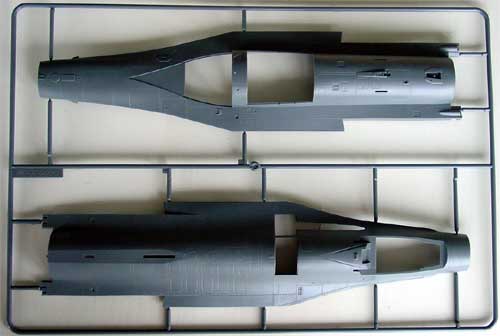
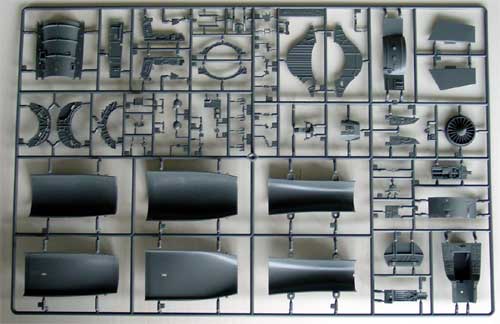
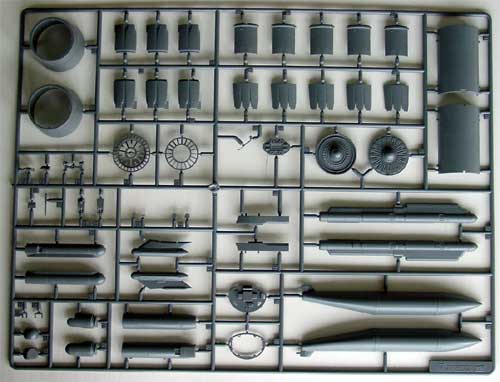
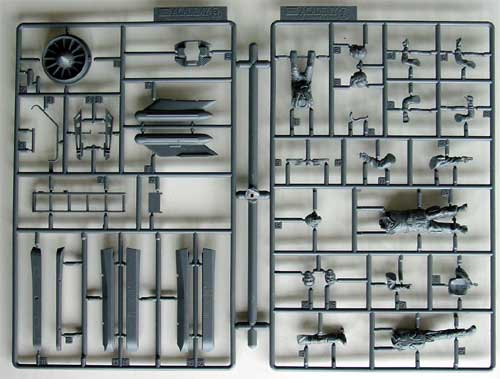
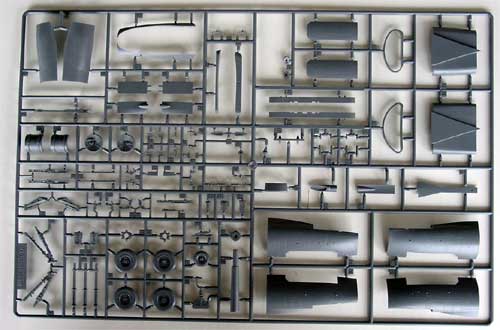
| The
box is really full with about 350 parts, most of them in light grey/white
plastic: 185 parts for the F-16, 25 for the separate F110 engine,
engine dolly 25, 100 for the stores and tanks, 15 parts transparent parts.
All is very nicely packed in separate bags and boxes. Parts have very fine
engraved paneling and some raised details as required.
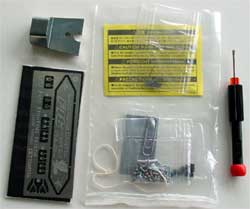
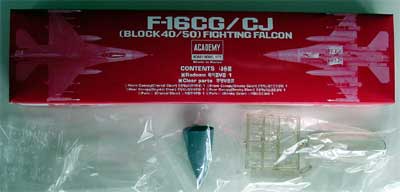
Also a number of metal parts are supplied for the undercarriage legs and some etched metal for chaff dispensers. Two canopies are supplied, plain glass and gold tinted glass. There is also a painting mask for the canopy, a set of rubber tires (no plastic ones being supplied). The kit is also supplied with small screws and a screwdriver to get some more strength in areas. A small sheet of remove-before-flight tags and a metal insert for the nose weight. A nice colour poster with paint schemes and photos completes this kit. [note:
|
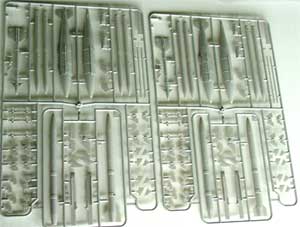
Box
full with about 370 parts in dark grey plastic: 200 for the F-16,
150 for the stores, 20 others. No metal parts are supplied as Academy thinks
this is not needed for the relatively small 1/32 kit. To save costs they
also did not supply you with etched metal or any other gimmicks, but the
plastic parts are just as detailed. And you indeed get two canopies with
plain glass or gold tinted glass. Tyres are of plastic which I think is
better.
All plastic has finely engraved details which is quite comparable to the Tamiya kit. However, strangely enough you will need to remove very subtle flash with a modelling knife in areas and need to polish the surface in areas. But nothing that can not be done with a little effort.
|
| PARTICULARS: | |
| You
don't only get a F-16 model, you also get a separate F110 engine with an
engine dolly. The engine can be installed and removed from the rear fuselage
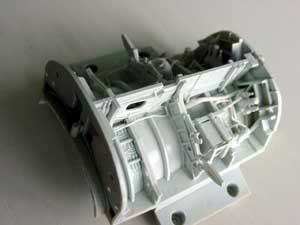
for which a detailed bay is provided with this kit.
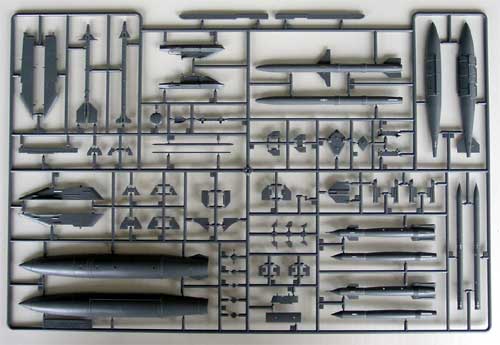
A good number of external stores are supplied, such as: AMRAAM 120B/C , AIM-9M , a ASQ-213 HARM target pod, AGM-88 HARM missile, ALQ-184 ECM pod, GBU-31J, and two tanks of 300 and one of 370 gallons. For the parts rubber/nylon parts are
supplied that enable you to keep them removable and changeable. The same
is done for the vertical tail and instrument cover. The idea is that you
can remove these parts for transporting the model in its own box after
finishing it. For that purpose you get a carton insert box with the kit.
|
-
you get an excellent F-16 model, not more not less. But 2 pilots and 1
crew member is an extra bonus. And you get much more, read this:
- Stores are superior! Very good quality and includes more than with the Tamiya kit: AIM-9L/M, AIM-9X, AIM-120B/C, AGM-88 HARM, GBU-31 JDAM, GBU-12 Also Paveways and TERs on the GBU-12; 2x 370 gallon tanks and 1x300 centerline fuel tank; ALQ-184 ECM and 2x HTS pod; LANTIRN pod; ALE-50 Fiber-Optic Towed Decoy. ASPJ antenna fairings on the intake. For the ROKAF a specific IFF type antenna panel is supplied. It seems a bit strange on the box picture but is correct. Parts do not seem so complicated as with the Tamiya kit but the end result is just as good.
|
| FIT: | |
| Very good | OK. |
| DETAILS: | |
| Superior!
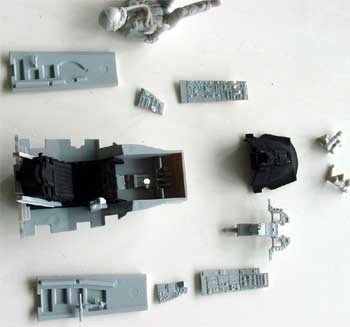
- Surface detailing very good - Cockpit: fine but small obviously. Raised instrument details, detailed sidewalls. Glass CRT screens and separate instrument cover with HUD. ACES II ejection seat is removable and quite good. Separate belts supplied. Good pilot figure and a ladder is also supplied. Very good cockpit edge locking details. The rear cover behind the seat (in front of the canopy actuator) is I feel is a bit too wide (about 2 mm); - Wing: separate leading edge slat and trailing edge flaps. One single part of upper fuselage and wing, which guarantees correct dihedral and no seams. Later style F-16 RWR receivers on leading edge and metal static dischargers. - Radar nose and radar is also supplied with very fine etched metal antenna. - Canon: also added but no ammo drum. Removable panels. - Air brakes can be set in open position.
|
Very good!
- Engraved paneling is a little less "busy" as compared to the Tamiya kit but the end result is just as good. - Cockpit is fine with no gimmicks such as removable seat rails. Looks fine. ACES II seat is OK but straps are moulded on (Remove these and make separate straps). 2 types of HUDs for the F-16CG/CJ and ROKAF. Ladder supplied with 2 pilot figures. Cockpit edge locking details are missing (add these from some stretched sprue and rod). The sidepanels' recesses should be a bit deeper. The rear cover behind the seat (in front of the canopy actuator) is I feel not wide enough (about 2 mm); - Wing: has only separate trailing edge flaps and 2 wing halves should be aligned and glued to the center wing section. Later style F-16 RWR receivers on leading edge and plastic static dischargers which are separate parts. - Radar nose and radar is also supplied but with plastic parts. Requires some added details. - Canon: also added and including the ammo drum. Removable panels. - Air brakes can be set in open position. |
| DECALS: | |
| TAMIYA
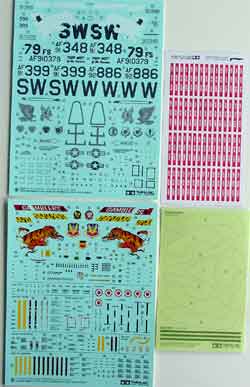
kit has 4 versions; decals are a bit thick but have good coloring and markings.
Only USAF versions: (1) 20 FW, SW Shaw AFB, USAF SerNo 91-0379, Block 50D, Tiger Meet of the Americas 2001 / (2) 77 FS, 20 FW, SW Shaw AFB, USAF SerNo 91-0348, Block 50D / (3) 13 FS, 35 FW, MJ Misawa Japan, USAF SerNo 91-0399, Block 50D / (4) 14 FS, 35 FW, MJ Misawa Japan, USAF SerNo 92-3886, Block 50P ;
|
ACADEMY
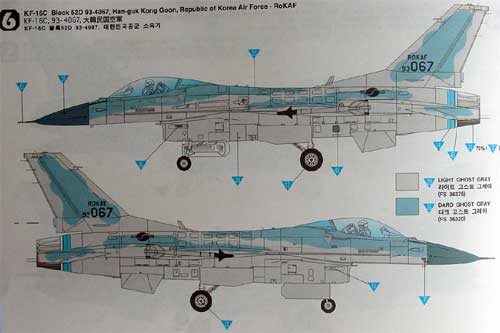
KIT has 6 versions: 5 for USAF and 1 ROKAF of Korea;
(1) F-16CG Block 40, 89-2013, 8 FW, Kunsan AB, South Korea, Sep 2004 ; (2) F-16CG Block 40, 89-2003, 35 FS/8 FW Kunsan AB, South Korea, Aug 2004; (3) F-16CG Block 40, 89-2020, 51 FW, Osan AB, South Korea, Sep 2004 ; (4) F-16CJ Block 50, 92-3895, 5 AF (35 FW), Misawa AB, Japan, Feb 2005 ; (5) F-16CJ Block 50, 92-3901, 35 FW, Misawa AB, Japan, Sep 2004 ; (6) KF-16C Block 52, 93-4067, Han-guk Kong Goon, RoKAF ; this has a "F-15" type scheme with Dark Ghost Gray and Light Ghost Gray. Very good set decals for the stores! 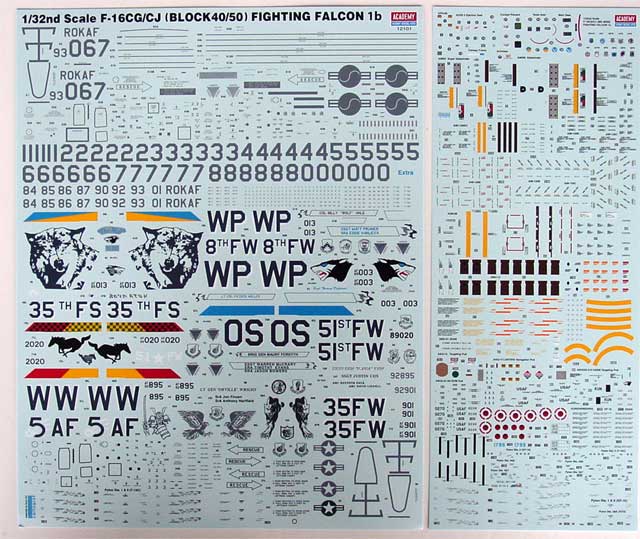
|
| REMARKS: | |
| -
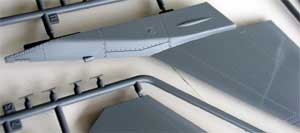
The vertical tail can be kept detachable, when fixed the very small seam
needs minimal filling.
- The engine can be set separate on its nice engine dolly, but you will need another exhaust pipe section which I took from another F-16 kit such as the one of Revell or Hasegawa. (note: the loose engine is a bit thin, otherwise it would not fit into the rear fuselage. But this can hardly be seen I think). - the aft lower rear fuselage cross section shape at the engine bay is not entirely correct; it seems some compromise was needed here as the engine and sub-parts are removable - the engine dolly is a model on its won and needs carefully aligning of the parts. - carefully assemble the big mouth intake, fill the seam. - stores are fine, missile fins are thin enough for me. - wheel bays need some extra piping and details. - some very small ejection pin marks can be found on the inner air brakes. Remove these. - overall fit is excellent!
|
-
this kit builds into a fine F-16. You get a choice here with several blocks
and big or small intakes and the corresponding 2 types of engine exhausts.
With some cross kitting with for example
the (now obsolete) Hasegawa kit, older blocks can be made. Many older block
aircraft have thin wheels and no bulged but straight main gear doors and
these are found in the older F-16 kits on 1/32 scale.
|
| CONCLUSION: | |
| A
very nice state of the art Tamiya model of unseen quality. But this comes
at a high price. I liked the engine and its dolly, but the aft lower fuselage
cross-section is not entirely correct.
Some extras were not really needed such as the nylon parts for removable parts or the transport facility. The kit would than have been cheaper. Recommended if you want to afford
it. NOTE: August 2005 Tamiya issued an older style F-16C Block 32 in the Thunderbirds scheme. It has the smaller intake and a "thick base" vertical tail of the "C". The model does not have the internal engine and engine bay. 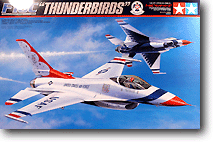
See also tips for converting the Tamiya Thunderbird into a F-16A |
This
Academy kit looks a bit "simpler" than the Tamiya kit but the end result
is just as impressive. You can make more choices and the stores are very
impressive.
This kit is
about 40% cheaper and immediately makes the Hasegawa kits obsolete as these
are not much cheaper.
Issue found
later:
|
| ON TO MODELLING
REPORT OF THE
TAMIYA F-16C KIT.... |
ON TO MODELLING
REPORT OF THE
ACADEMY F-16C KIT.... |
| .
ON TO MODELLING REPORT OF THE ACADEMY conversion to F-16B |
.
ON TO MODELLING REPORT OF THE ACADEMY F-16I SUFA KIT.... |
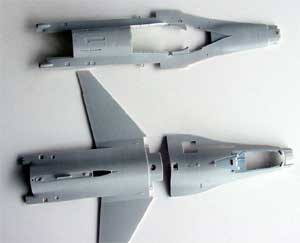
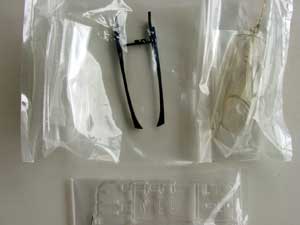
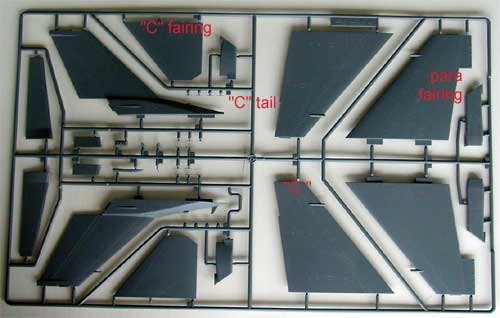
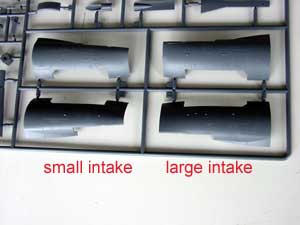
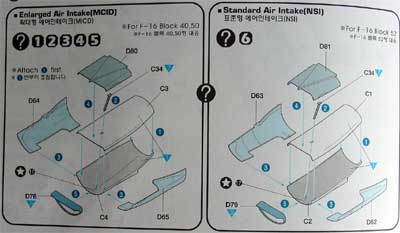
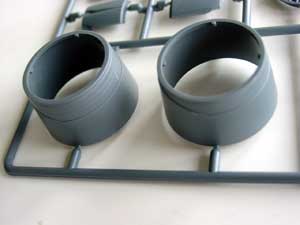
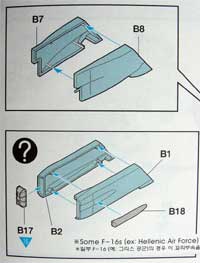 "para tail choice"
ALSO CHECK
OUT:
EXTENSIVE
BUILD OF
THE HASEGAWA KITS HERE.......
..
Back
to 1/32 models
More than 30 pages with over 30,000 words and 700 images
MY WALK AROUND REAL F-16 PAGE
Great site here: www.F-16.net
Check WikiPedia for the various operators...
For Royal Netherlands Air Force (KLu) F-16 info look at the IPMS Nederland info pages here...
A very good
REFERENCE is the Daco book :
“Uncovering
the Lockheed Martin F-16 A/B/C/D” with many many pictures…. (note: drawings
are not accurate in all areas)
THE JAPANESE JASDF
F-2 FIGHTER,
the F-16 Look Alike HERE...


(c) Copyright "designer"/ All rights reserved. Your comments are welcomed by webmaster
Last Update
January 2019;
.
Created this F-16 topic
May 7, 2005