F-15 Eagle
[Page 1]


F-15 models in 1/32 scale made by Meindert de Vreeze
Revell and Tamiya
VARIANTS:
see also the 1/72 pages...
Modelling report
page 1
page 2
page 3
page 4
page 5
page 6
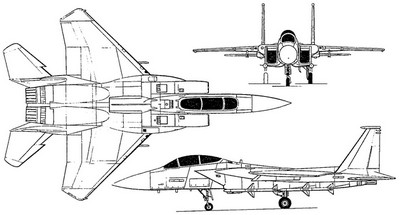
The F-15 Eagle from McDonnell Douglas, now being produced by Boeing is an interesting modelling subject. In the large 1/32 scale there are a couple of excellent models of the F-15 available. This modelling report will deal with an F-15C and an F-15D of Revell and an F-15E of Tamiya converted into and F-15I.
But first lets have a short look at details of the real plane.
Historical
Background
The F-15 ,
called the Eagle, originated as an all-weather, extremely maneuverable
tactical fighter designed to gain and maintain air superiority in aerial
combat. It is maneuverable and has a great acceleration with two Pratt
& Whitney F100-PW- series engines with afterburners, a large range,
a large weapons choice and excellent avionics.
The Eagle fighter variants can be armed with different air-to-air weapons. The first variants, the F-15A single seater and F-15B two seater trainer can carry AIM-7 Sparrow missiles on lower fuselage corners, AIM-9 Sidewinder on two pylons under the wings, and have an internal 20mm Gatling gun in the right wing root. In addition, large fueltanks can be carried on the central and two wing pylons.
The first F-15A flight was made in July 1972, and the first flight of the two-seat F-15B (formerly TF-15A) trainer was made in July 1973. The F-15A became operational in 1976.
The F-15C and D versions were developed from the A and B and received avionics updates. They can also be armed with AIM-120 advanced medium range air-to-air missiles and more modern versions of the Sparrow and Sidewinder missiles. They also have a single large antenna pod on top of left vertical tail and some additional antenna. Otherwise, these later models look externally very similar to the earlier A and B versions.
Low-drag, conformal fuel tanks were especially developed for the F-15C and D models. The conformal fuel tanks can be attached to the sides of the fuselage. C and D models often fly without the conformal fuel tanks and without the P&W engine covers, called "Turkey feathers" to save weight. The single-seat F-15C and two-seat F-15D models entered US Air Force in 1979.
The F-15J was a version of the F-15C made for Japan with some special internal equipment. Externally it is very similar to the F-15C. Most were manufactured under license by Mitsubishi Heavy Industries.
The F-15E is a two-seat, dual-role, totally integrated fighter for all-weather, air-to-air and deep interdiction missions. The two crew members are a pilot and a weapon systems officer. The F-15E became operational in 1988. The rear cockpit is upgraded with new panels to include four multi-purpose CRT displays for aircraft systems and weapons management. Is also usually carries the conformal fuel tanks. The pilot's instrument panel also was improved with several instruments.
Also, the F-15E can make use of special mission equipment and pods, such as the low-altitude navigation and targeting infrared for night (LANTIRN). It consists of a navigation and targeting pod attached to the exterior of the aircraft. The F-15E has also the internal 20 mm gun and can also carry besides dumb bombs and guided bombs the usual F-15C missiles for air defence. In most cases it carries a couple of Sidewinder missiles to pylons for self defense. The F-15E has two larger antenna pods on top of the verical fins.
The F-15E was the basis for a special Israeli version. This F-15I Ra'am is a special version that entered service in January of 1998 in Israeli service. It is capable of a higher weights and some better performance than the F-15E. Missiles that can be carried include Israeli Python A-A missiles but also the normal loads of the F-15E can be carried, including the LANTIRN system. The Python 4 is compatible with standard AIM-9 Sidewinder missile capable launchers. Externally, the F-15I is very similar to the F-15E, but engine exhausts always carry the Turkey Feathers and on top of the vertical fins, only the flutter weights are carried. Below the wing, large cooling intakes are present of both sides of the conformal fuel tanks ("fast packs"). Also some chaff dispensers are located at the lower tailbooms near the engine pipes.
The F-15 was upgraded in several "Multi-stage Improvement Program" MSIP phases for the USAF from the mid 1980s. The MSIP mainly involved an APG-70 radar with improved missile capability for the AIM-120 AMRAAM and advanced Sidewinders. System updates and improved ESM capability were also deployed. The Japanese F-15J MSIP involves an APG-63 upgrade, F100-IHI engines, new ejection seat and the Japanese AAM-4 'type 99" missile. Link 16 and helmet mounted sights as well as AAM-5 "Type 04" missile are also envisaged for the JASDF.
From 2019, for USAF aircraft plans are to extend the F-15 usage until the 2030s with a joint multi mission planning system and the APG-82 radar. (next to the F-35 fleet).
Plastic scale models
In 1/32 scale, there are two kit manufacturers that issued F-15 kits in different versions, Tamiya from Japan and Revell from Germany/USA. (NOTE: I also made several 1/72 scale F-15 models: see the 1/72 F-15 page here...)
REVELL
First came Revell that issued the
F-15C in 1985 in 1/32 Scale, kit # 04759. The kit appeared also in an "updated"
kit, with better seats and a choice with or without engine Turkey feathers;
this latter choice's parts are a bit rude. In some releases of this kit
you get an extra set of parts in a separate sprue. It had nice markings
for a USAFE 32 TFS Soesterberg plane. 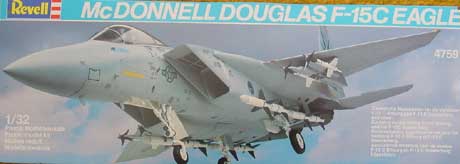
One of the kits released was an F-15C
with an Anti-Satellite missile envisaged for the "Star Wars" project. When
you nowadays buy a Revell kit, you also often get these extra parts. Unfortunately
you do not get any fueltanks which are so often seen under an Eagle. (Cutting
Edge has 600 gallon fuel tanks from resin in their catalogue under number
CEC32179).
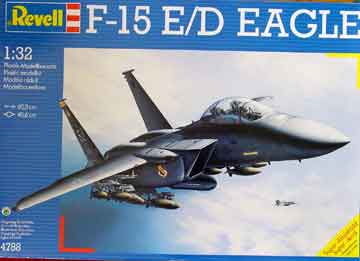
Also, later on they issued a modified kit in 1992 as the F-15E/D Kit # 04788, of which you could also make an F-15D. It has obviously a new canopy, two seats and slightly different forward fuselage parts than the "C".
From the F-15E/D kit, an "E" prototype
model can be made with iron bombs, but no special pylons. It has fortunately
the fastpacks, but they forgot the chaff/flare dispensers under the tail
booms that were fitted on operational types. When you want to make a F-15B
or F-15D, you have to correct the supplied F-15E instrument panels....
 #4788
#4788
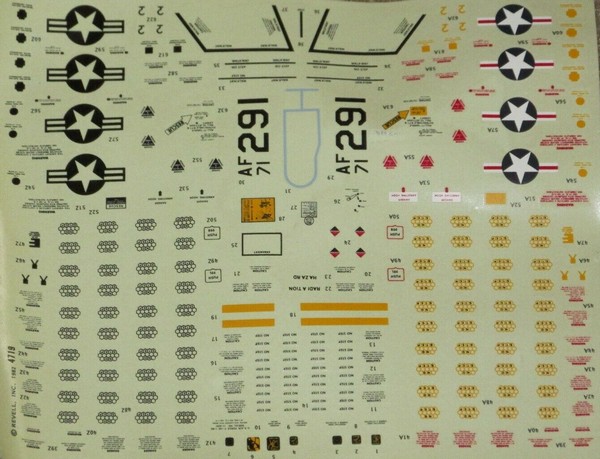
The released kits often had new sets
of decals, very good ones with a large box filling sheet!
The Revell kits are very nice and typical of Revell. Accurate, not too complicated, acceptable detail and comes at a good price.
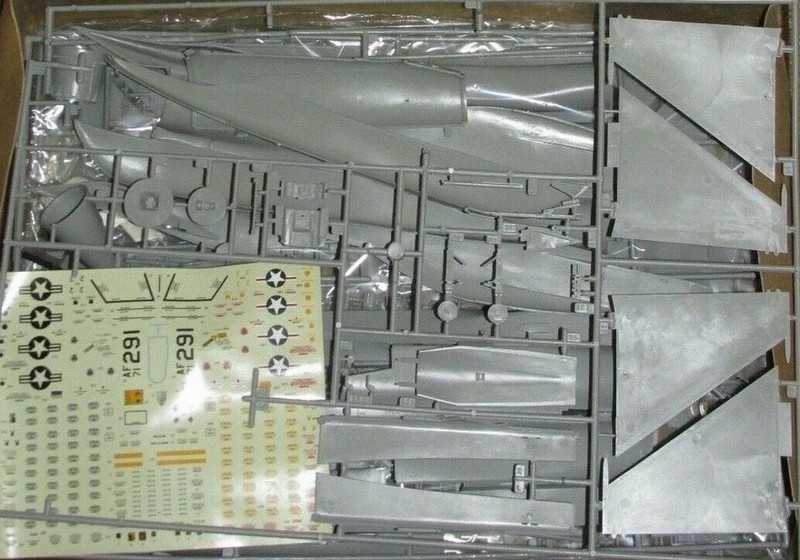
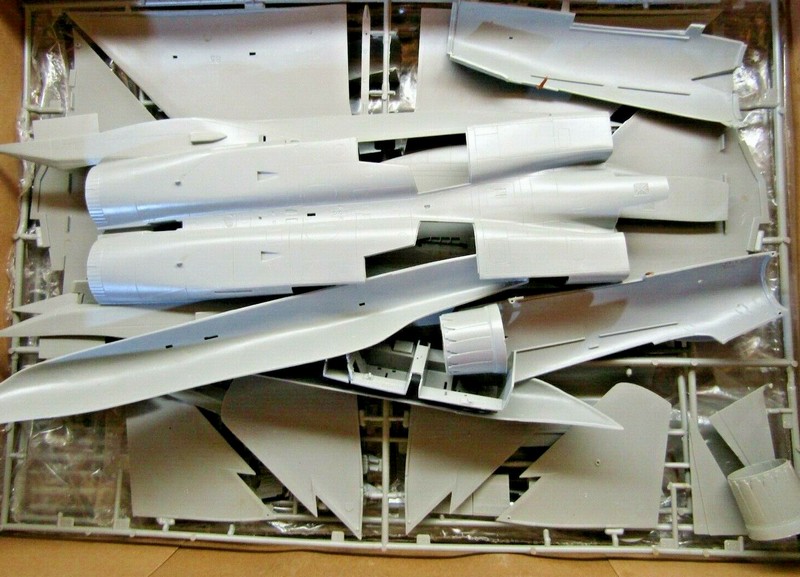
Sometimes a tinted canopy was in a release, such as the F-15E Revell #4719 release. Not very usable!
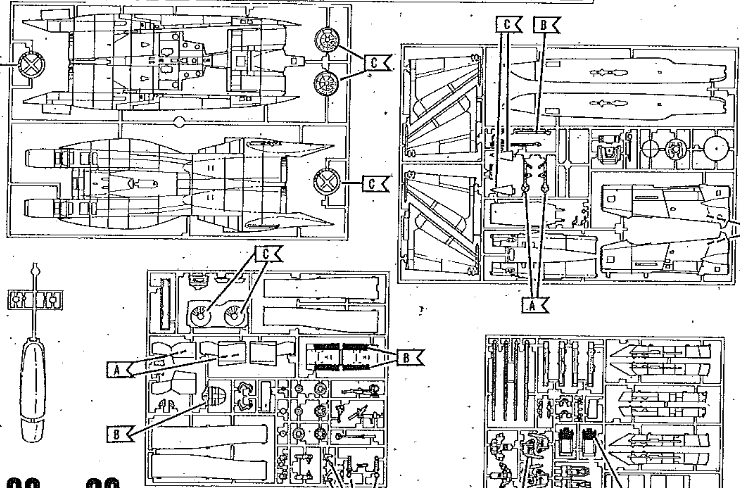
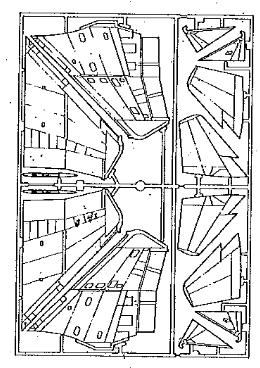
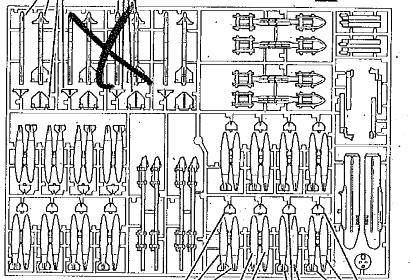
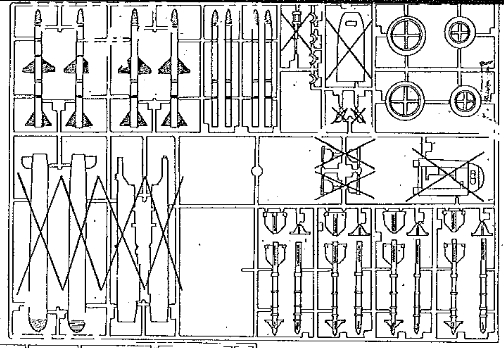
Some parts in the Revell kits are a bit simple to keep the kit's costs low, such as the cockpit seats, the radar detailling, the exhaust pipes (with or without "turkey feathers") and the "stores" are all there although a bit simple. Adding details in these areas and/or replacing some of these parts will improve the overall result.
But the Revell kits have engraved panellines but no fasteners/rivets details. It is noted however that on modern fighter planes these are flush and hardly visible.
TAMIYA
Tamiya released an F-15E in 1992,
and this kit is very impressive.
The Tamiya kit has finer recessed
panellines than the Revell kits and has finer details, but it is expensive...
With kit # 60302 you can make an
excellent up to date in service' model, with stores such as the LANTIRN
pod, but unfortunately only 1 external large fueltank. The Tamiya F-15
kits have been released in slightly different versions as far as
I know as the F-15C, F-15J and the F-15E Strike Eagle and a F-15E with
a buster bomb. They all have the special appropriate distinct features
of the variants.
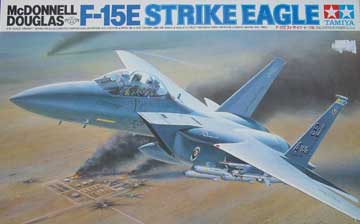
Contrary to the Revell kit the Tamiya
kits have a high price tag as you can buy about 4 Revell kits for each
Tamiya kit. The Tamiya kit has more and some finer detail. It has superior
engraving of panels, and a bit overdone fasteners etc. It looks impressive
however, with good instrument panels, nice ACES seats.
The wheels as in the kit are the
heavier type late F-15 style (like the F-15E) , with bulged doors and thicker
tyres.
MORE ON THIS KIT STARTS ON [Page
5]
Both Revell and Tamiya 1/32 scale
kits have their pro's and con's but both can be made in an impressive accurate
model.
The three kits are to be finished
as follows:
A=
Revell F-15C single seat fighter converted into a F-15J for Japan 204 squadron
aircraft 10th aniversary
B=
Revell F-15B trainer/fighter, to be finished in the 32 TFS Soesterberg,
USAFE
C=
Tamiya F-15E to be converted into a F-15I Ra'am: a version of the F-15E
as made for Israel with desert camouflage.
OK.... On to next [ PAGE 2 ....]
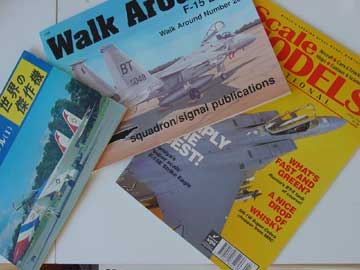
- Walk Around 28, Lou Drendel, Squadron Signal USA
- F-15, BunRin Do 1978/3, Japan
- Scale Models magazine, April 1994 about Tamiya F-15E, U.K
- see my 1/72 F-15 page here...
YouTube
- JASDF F-15J
Video 1 at YouTube
- JASDF F-15J
Video 2 at YouTube
- JASDF
Video at YouTube
- Website Boeing at
http://www.boeing.com/defense-space/military/f15/flash.html
Deagel combat aircraft site (F-15)

(c) Copyright "designer"/ All rights reserved. Your comments are welcomed by webmaster
Created October 17, 2004;
updated April 2019